OECD report identifies five bottlenecks behind the advanced STEM and AI-skills gap
OECD’s Oct. 23 report on advanced STEM skills names AI literacy a core foundation and cites a survey finding 70% of Japanese employers lack AI skills.
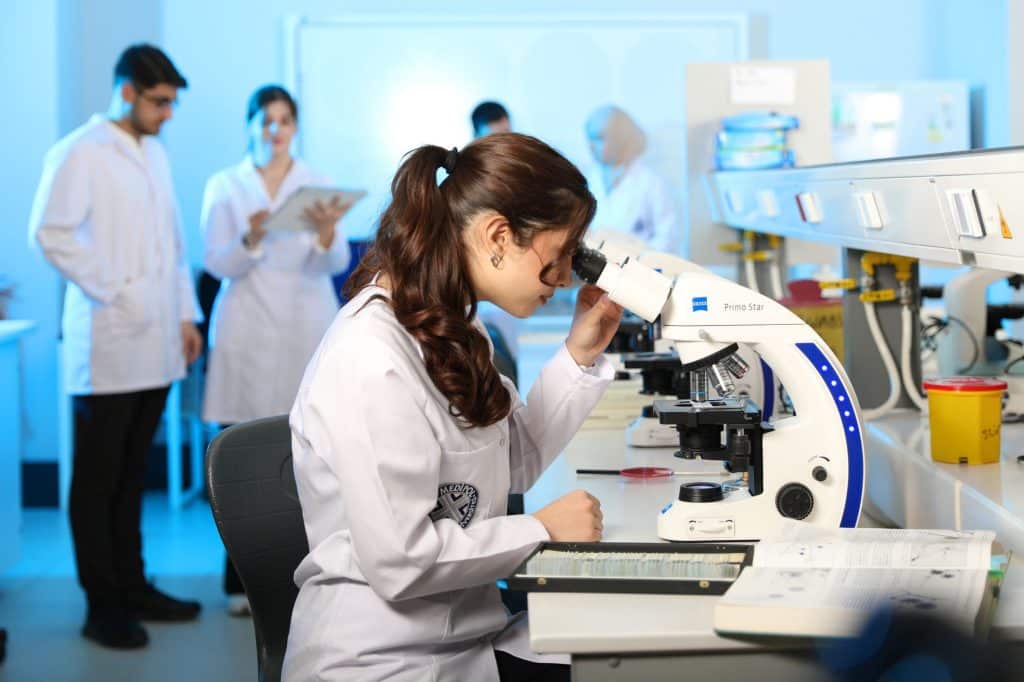
Photo by Yusuf Çelik on Pexels
The OECD published a report on October 23, 2026, titled “Policies for Developing Advanced STEM Skills in Higher Education,” arguing that AI literacy and STEM skills are becoming inseparable and identifying five bottlenecks that constrain how countries develop and use advanced science, technology, engineering and mathematics skills. The report, produced by the OECD’s Directorate for Education and Skills through its Mutual Learning Group on Advanced STEM Skills in Higher Education, states that “scientific literacy and AI literacy provide essential foundations for advanced STEM skills,” enabling people to judge the reliability of both scientific claims and AI-generated outputs.
The report illustrates the point with a hospital introducing an AI system to support clinical decisions: computer scientists build the model, but clinicians must judge whether its outputs are medically meaningful, engineers must integrate it with existing systems, and legal specialists must address privacy and bias. “General AI literacy may enable participants to understand that an AI system has limitations and should not be followed uncritically,” the report states, while advanced STEM skills are what let specialists validate the model, interpret its uncertainty and take professional responsibility for the decisions it informs.
Five bottlenecks, four policy priorities
The report frames advanced STEM skills, not as a fixed set of degrees or job titles, but as four dimensions of competence (disciplinary, interdisciplinary, transversal and professional) that develop cumulatively and can stall at five points.
| Bottleneck | What it covers |
|---|---|
| Entry into STEM higher education | Who chooses and gains access to STEM study |
| Persistence and completion | Staying in and finishing STEM programmes |
| Progression to advanced levels | Moving from foundational to advanced STEM study |
| Career entry and effective skills use | Finding work that actually uses advanced skills |
| Skills renewal across working life | Keeping skills current as technology changes |
Source: OECD, “Policies for Developing Advanced STEM Skills in Higher Education,” October 23, 2026.
Building on that framework, the report sets four policy priorities (entry, persistence and completion; progression and skills renewal; programme renewal; and career entry and effective skills use) and closes with eight recommendations for governments, institutions and employers. It cautions that reported STEM “shortages” are hard to measure, since qualifications are an imperfect proxy for skills and employer recruitment difficulties can reflect pay, location or narrow hiring criteria rather than a genuine skills gap.
A widening AI-skills gap among employers
The report cites a 2025 Linux Foundation survey of organisations in Japan that found a positive net hiring effect from AI adoption but also reported that more than 70 percent of employers lacked sufficient employees with AI-related skills. The OECD report says Japan’s policy response “places considerable emphasis on skills renewal among the existing workforce,” rather than relying only on initial education, to close that gap.
Elsewhere, the OECD report cites a separate strand of research by Zegart and Johnston (2026) finding that international students earned 51 percent of United States STEM master’s degrees and 39 percent of STEM research doctorates, while the share who remain in the country after graduating has fallen below their own stated intentions, a pattern the report says shows why skills policy needs to address education, research, employment and immigration together rather than enrolment numbers alone.
Why this matters for AI literacy in schools
The report ties its STEM framework directly to ongoing AI literacy work. It notes that while basic scientific literacy is measured internationally among 15-year-olds through the OECD’s Programme for International Student Assessment (PISA), “frameworks and assessment instruments for AI literacy remain under development, including for the planned PISA 2029 assessment of media and AI literacy.” It defines AI literacy by reference to the OECD and European Commission’s own joint framework, which launched an AI literacy framework for schools earlier this year.
The report’s emphasis on AI literacy as a foundation for STEM work follows a string of related funding and skills initiatives Winss Solutions has tracked, including IBM’s Impact Accelerator programme, which brought AI and quantum tools to four education and workforce nonprofits, and earlier findings that STEM education still has unfinished business heading into 2025 and that Europe faces a widening skills gap through 2035 across IT, social and technical fields.
Background
The OECD is an intergovernmental organisation of 38 member countries, based in Paris, that produces comparative data and policy analysis across education, economic and social fields. Its Directorate for Education and Skills runs PISA and the Teaching and Learning International Survey (TALIS), and in 2026 it has repeatedly tied generative AI’s spread in classrooms to broader skills-policy questions, including through the OECD Digital Education Outlook 2026 and the joint OECD/European Commission AI literacy framework for schools. The Mutual Learning Group on Advanced STEM Skills in Higher Education, which produced this report, drew on researchers, policymakers and higher education practitioners from multiple countries over 2024-26 and supports implementation of the European Union’s 2025 STEM Education Strategic Plan. The report’s central claim, that AI literacy now sits alongside scientific literacy as a prerequisite for advanced STEM competence, places the OECD’s STEM-skills agenda and its AI-in-education agenda on the same track for the first time.
Sources: OECD; Devdiscourse
Featured image: photo by Yusuf Çelik on Pexels (free Pexels license).
Become a Sponsor
Our website is the heart of the mission of WINSS – it’s where we share updates, publish research, highlight community impact, and connect with supporters around the world. To keep this essential platform running, updated, and accessible, we rely on the generosity of you, who believe in our work.
We offer the option to sponsor monthly, or just once choosing the amount of your choice. If you run a company, please contact us via info@winssolutions.org.

I specialize in sustainability education, curriculum co-creation, and early-stage project strategy. At WINSS, I craft articles on sustainability, transformative AI, and related topics. When I’m not writing, you’ll find me chasing the perfect sushi roll, exploring cities around the globe, or unwinding with my dog Puffy — the world’s most loyal sidekick.